


As 2026 unfolds, the U.S. labor market is experiencing a period of stabilization and adjustment. After several years of rapid hiring and tight labor conditions, employment growth has moderated. Market dynamics, demographic shifts, and evolving policies are shaping a more measured pace of hiring, without causing widespread layoffs.
This shift reflects a broader cooling cycle rather than a sudden contraction. Payroll growth weakened throughout 2025. Monthly job creation averaged 50,000 positions and fell to 29,000 between June and August. Unemployment rose by 30 basis points between January and October. Job openings continued to decline. At the same time, rising trade costs increased pressure on corporate budgets, with static tariff rates reaching an estimated 16.5 percent, affecting more than USD 500 billion in annual imports.
These conditions have made long-term planning more difficult for employers. As Michael Feroli, Chief U.S. Economist at J.P. Morgan, has observed, “Businesses are hesitant to make sweeping changes to either grow or shrink their payrolls when they’re unsure what the next six months might hold.” Hiring and layoffs have both remained subdued.
For employees, this has produced a market defined less by instability than by hesitation. Jobs are not disappearing at scale, but new opportunities are emerging more slowly. In this context, relying solely on a job seeker’s resume is increasingly insufficient to navigate evolving hiring expectations. Understanding this environment requires moving beyond surface-level indicators and examining how companies now make employment decisions.
The Structure of the 2026 Employment Landscape
The employment landscape in the first half of 2026 suggests a softening in hiring momentum. Several indicators help explain the current employment landscape.
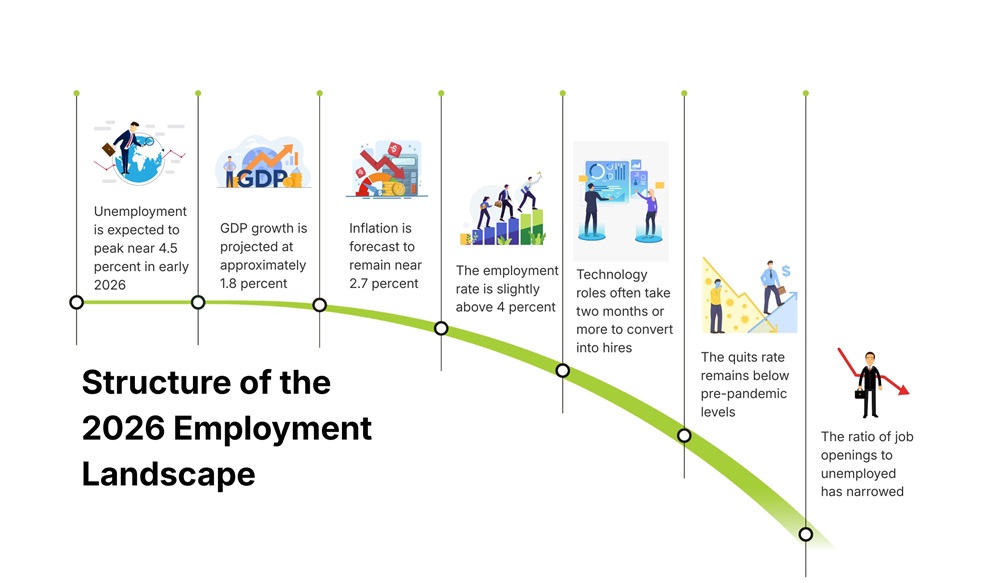
These data points point to a market that is stable but constrained. Companies continue operating profitably in many sectors, and consumer demand has not collapsed. As a result, firms have limited incentives to implement large workforce reductions. At the same time, slower growth and cost pressures discourage rapid expansion.
Hiring timelines have lengthened. Internal approvals now involve more layers of review. Many organizations prioritize experienced professionals who can contribute immediately rather than investing in extensive onboarding for early-career candidates. Entry-level hiring, in particular, has softened, forcing candidates to rethink their job search strategy in a slower-moving market.
This environment has prompted analysts to describe the market as frozen rather than weak. According to Sarah Foster, an economic analyst for Bankrate and the author of a new report analyzing the job market, “This is one of the worst times to really find a new job since the aftermath of the Great Recession.”
And this has been intensified due to competition. Candidates with relevant qualifications, industry recognized certifications, and experience compete for a limited pool of opportunities. Interview processes stretch across multiple months. Employers delay decisions until uncertainty narrows.
Why Traditional Job Searches Are Losing Effectiveness
Earlier hiring patterns placed greater emphasis on volume, enabling applicants to improve outcomes through a higher volume of applications. Applicants could increase their odds by submitting large numbers of resumes. Automated systems filter candidates based on degrees, job titles, and keyword alignment. Human reviewers then narrowed the pool.
That model is no longer sufficient.
Modern roles often require hybrid capabilities that do not fit neatly into standardized descriptions. A job seeker resume can document past employment but rarely conveys how someone solves unfamiliar problems, collaborates across functions, or adapts to evolving technologies.
Several structural changes have weakened the resume’s central role:
- First, careers have become more fragmented. Professionals increasingly combine full-time roles with freelance projects, certifications, and cross-disciplinary work. These experiences are difficult to summarize in traditional formats.
- Second, applicant tracking systems rely heavily on linguistic matching. Minor differences in terminology can lead to automatic rejection, even when underlying skills are strong.
- Third, organizations are placing greater emphasis on predictive indicators of performance. Past job titles are less informative in environments where roles change rapidly.
As a result, companies are shifting toward alternative evaluation methods. These include:
- Skills-based assessments that simulate job tasks
- Portfolio reviews that demonstrate applied expertise
- Structured interviews that standardize comparisons
- Psychometric tools that measure learning capacity and work styles
This transition reflects a broader move from credential-based screening to capability-based evaluation, requiring a more deliberate job search strategy that emphasizes demonstrable outcomes over static credentials.
Get tailored updates that match your industry, role, and ambitions — so you always know what to learn next.
Subscribe nowThe Rise of Relationship-Centered Hiring
Alongside technical assessments, interpersonal networks now play a larger role in hiring decisions. As uncertainty increases, organizations prefer candidates who arrive with some degree of internal validation.
Referrals, alumni networks, and professional communities function as risk-reduction mechanisms. A recommendation from a trusted source lowers the perceived cost of a hiring mistake. Informal conversations often precede formal interviews.
Many positions are filled before public posting. Internal mobility programs, talent pools, and private recruiting channels allow firms to source candidates quietly. Job boards increasingly represent only a portion of available opportunities, making a purely application-driven job search strategy less effective.
For applicants who rely exclusively on online applications, this creates structural disadvantages. Visibility within relevant networks often matters more than submission volume.
Strategic Responses for Job Seekers
Success in a constrained market requires alignment with current employer behavior. Five approaches have become particularly important.
- Establish Verifiable Skill Signals
Demonstrated work carries more weight than stated competence. Case studies, published analyses, project repositories, and documented outcomes provide concrete proof of capability. These materials reduce uncertainty for hiring managers and support interview discussions.
Professional certifications provide formal validation of specific competencies, complementing demonstrated work. For instance, certifications such as STMP™ certification from TMI in talent management or CAiBP® Charter from ARTiBA in AI business applications, indicate domain-specific expertise and a structured understanding of industry practices when aligned with relevant roles.
Visibility matters. Employers are more likely to engage with candidates whose expertise is accessible, clearly documented, and supported by credible, verifiable signals.
- Shift from Mass Applications to Targeted Outreach
High-volume application strategies produce diminishing returns. Targeted networking is more effective. Participation in industry forums, professional associations, and sector-specific events creates access to informal hiring channels.
The objective is not transactional networking but sustained professional presence. Consistent engagement increases recognition over time.
- Clarify Professional Positioning
Employers evaluate candidates based on future contributions, not past activity. Effective positioning focuses on problem-solving capacity and measurable impact.
Rather than listing responsibilities, professionals benefit from articulating how their work improved systems, reduced costs, increased revenue, or strengthened operations. This framing aligns experience with organizational priorities.
- Maintain Structured Upskilling
Ongoing technological shifts continue to reshape job requirements. Technical literacy, data fluency, and cross-functional knowledge have become baseline expectations in many roles.
Continuous learning signals adaptability. Certifications, formal coursework, and applied training reduce perceived obsolescence and support long-term employability.
- Manage Professional Visibility Intentionally
Careers increasingly resemble public portfolios. Online profiles, published commentary, and participation in professional discussions contribute to reputation formation.
Consistency matters. Messaging across platforms should reinforce core expertise and strategic focus. This coherence makes candidates easier to evaluate and remember.
Each of these elements strengthens a modern job search strategy, ensuring candidates remain competitive even when hiring slows.
Sectoral Differences and Selective Growth
While aggregate hiring remains subdued, demand varies by field. Growth is concentrated rather than uniform.
Healthcare remains constrained by persistent labor shortages, sustaining demand for clinical professionals. According to Chris Graham, Executive Vice President of Workforce Education Solutions at National University, technology and cybersecurity continue to attract investment as AI adoption accelerates, while persistent workforce shortages are also driving sustained demand in healthcare, particularly in medicine and nursing.
These sectors benefit from structural drivers rather than cyclical momentum. Long-term demographic trends, regulatory requirements, and technological dependence create durable hiring needs.
By contrast, discretionary services, traditional retail, and low-margin manufacturing face tighter constraints. Opportunities exist but appear less frequently.
End Notes: Competing in a Cautious Environment
The 2026 hiring landscape is defined by restraint. Employers are cautious. Hiring decisions undergo extended review. Competition is elevated. Traditional job-search methods yield weaker results. This environment does not indicate systemic decline. It reflects recalibration after years of rapid expansion. Organizations are optimizing efficiency and resilience rather than growth at any cost.
For professionals, this shift demands corresponding adjustments. Career progress depends on demonstrable skills, credible networks, disciplined positioning, and continuous development. In this context, a well-defined job search strategy becomes a critical differentiator. Blazeprep connects to the world’s most trusted certifications, supporting candidates in navigating certification pathways with greater clarity and alignment to job market expectations.
Outcomes reward clarity and preparation. Those who align their strategies with current institutional realities are more likely to advance, even in a period of limited mobility. In a constrained environment, momentum comes from alignment rather than volume.
Still figuring out your next step?
You don’t have to navigate it alone. Get clarity on certifications that keep you ahead, not just up to date.
Talk to a Program Advisor