



What if faster decision-making depends on devices, not centralized cloud systems?
For many years, enterprise intelligence followed a familiar pattern. Data moved from devices to centralized systems, analysis happened in the cloud, and decisions followed processing delays. That model worked in the past. Today, neither condition holds.
Embedded AI represents a fundamental shift in how organizations deploy intelligence. This transition marks a move from "Cloud-First" to "Edge-First" intelligence. An Edge-First approach processes data and makes decisions closer to where it is generated, while a Cloud-First model relies on centralized cloud servers for most processing and decision-making.
In the past, devices acted as simple data collectors that sent information to a central hub. Today, embedded artificial intelligence allows these devices to analyze, interpret, and act on data in real-time at the point of origin.
Currently, over 60% of organizations adopting embedded AI report improved responsiveness and real-time processing capabilities, fueling agility across sectors like manufacturing, healthcare, and finance. This shift has implications beyond technology architecture. It changes how work is structured, how decisions are made, and how professionals create value; strongly impacting job-readiness skills for AI professionals.
With the embedded AI market projected to grow at a 22% CAGR through 2030, this technology is reshaping the future of automation, empowering enterprises to operate with unprecedented speed and security.
For professionals, this raises a practical question: how is AI going to change the future when intelligence becomes invisible, continuous, and embedded?
Why 2026 is a Pivotal Year: What Experts Predict
AI adoption will deepen, not plateau. Major research bodies highlight the scale of the coming changes:
- McKinsey reports that nearly nine in ten organizations already use AI in at least one business function.
- Deloitte expects one-quarter of companies using generative AI to pilot autonomous or “agentic” AI systems by 2025, rising to half by 2027.
- Gartner goes further, predicting that by 2028, at least 15 percent of daily work decisions will be made by AI agents.
The implication is structural. AI will no longer appear as something separate that workers must consciously invoke. It becomes part of the system itself. When intelligence is embedded, the boundary between human judgment and machine support becomes less visible. Professionals focus on outcomes and oversight rather than executing every step manually.
This also helps explain why adoption accelerates. Embedded AI reduces friction. Workers do not need to change behavior dramatically or learn entirely new tools. They continue working within familiar systems, while AI operates alongside them.
Get tailored updates on certifications and future-ready skills.
Subscribe NowCareer Impact and the Nature of Work
The most visible concern around AI remains about job displacement, about how is AI going to change the future of work. Research suggests that many roles will change, and some will disappear. However, evidence consistently shows that tasks are affected more than job titles.
The most important shift is not job loss. It is a redesign of job-readiness skills for AI professionals.
McKinsey estimates that by 2030, one can expect up to 12 million occupational changes due to automation and AI. This does not mean mass unemployment. It means routine tasks disappear faster than roles do. This shift reframes AI for professionals as an embedded capability that augments judgment rather than replaces roles.
Professionals will need AI-adjacent skills like AI prompt engineering, AI workflow automation, without needing deep coding expertise. You do not need to build models. You need to work effectively with systems that already embed AI. Developing these capabilities is central to AI for professionals, ensuring they can leverage intelligence in real-time to enhance outcomes.
For example, PwC found that professionals with AI-related skills (such as prompt engineering) command about a 56% wage premium on average. Every industry surveyed pays more for workers who can leverage AI. Roles that combine domain knowledge with AI literacy (for instance, an analyst who can instruct an AI model to explore data) will be highly prized.
Deloitte notes that as AI handles the routine parts of work, uniquely human capabilities become more important. These include:
- Empathy
- Leadership
- Creativity
- Complex problem-solving
- Critical thinking
- Communication
- Adaptability
- Ethical reasoning
These are exactly the areas where AI has limitations. In short, professionals should expect work to be reorganized around outcomes, the goals machines and humans can achieve together.
Skills to Start Building Now
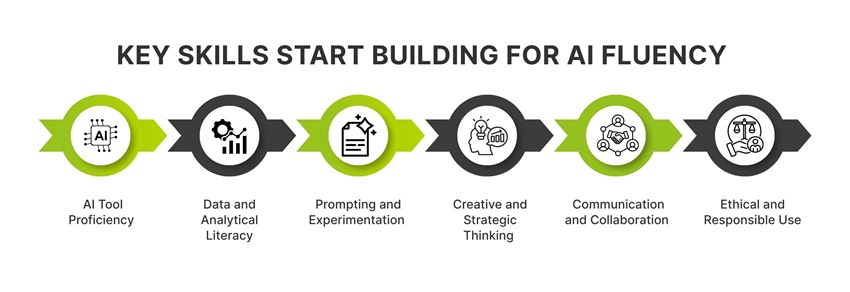
- AI Tool Proficiency
Most enterprise software now includes embedded AI assistants. Learning to use these tools effectively is becoming a baseline expectation. Drafting documents, summarizing meetings, exploring datasets, and automating workflows are increasingly supported by AI features built into everyday platforms. The advantage comes from understanding where these tools add value and where human review is necessary.
- Data and Analytical Literacy
As AI generates recommendations, professionals must understand how to interpret them. This does not require advanced statistics, but it does require comfort with charts, trends, and basic analytical reasoning. Professionals who can contextualize AI-generated insights make better decisions than those who treat outputs as definitive answers.
- Prompting and Experimentation
An emerging capability is the ability to frame problems clearly for AI systems. Small changes in instructions can produce materially different results. Learning to structure inputs, iterate outputs, and evaluate responses critically improves effectiveness across roles.
- Creative and Strategic Thinking
AI excels at pattern recognition, not originality or contextual judgment. Professionals who question assumptions, explore alternatives, and synthesize insights across domains remain essential. Using AI to reduce administrative workload creates space for higher-level thinking rather than replacing it.
- Communication and Collaboration
As work becomes more AI-assisted, the ability to explain reasoning, align stakeholders, and collaborate across technical and non-technical teams grows in importance. Clear communication ensures that AI-driven insights translate into real organizational decisions.
- Ethical and Responsible Use
Understanding AI limitations, bias risks, and data governance is increasingly part of professional responsibility. Organizations rely on workers who can identify when AI outputs require scrutiny and apply judgment accordingly.
Together, these capabilities define job-readiness skills for AI professionals, regardless of industry or role.
How Students & Early-Career Professionals Can Prepare
The best way to thrive in an AI-embedded future is proactive preparation. Experts consistently urge continuous learning and experimentation. For students and early-career workers, this means preparing for understanding how AI is going to change the future of work:
- Build Foundational Tech Literacy:
Even non-technical roles benefit from understanding the basics of data and AI. Skills in data literacy (knowing how to collect, interpret, and question data) and automation fundamentals (writing simple scripts or using automation tools) are increasingly expected. Online platforms offer AI courses and certifications, which can demonstrate concrete ability beyond vague “AI familiarity.” Many recruiters now scan for proof of skills.
- Develop Critical Thinking and Communication:
As AI automates routine tasks, uniquely human skills become more valuable. Critical thinking, creativity, and strong communication help ensure AI is used wisely. For example, if an AI suggests a marketing strategy, the human must assess its relevance and ethical implications. Cultivating adaptability and a growth mindset is important: surveys show students who view technology as a learning tool (not a threat) perform best with AI, strengthening their readiness for AI for professionals roles.
- Stay Hands-On and Curious:
Seek out opportunities to work with AI tools even before employers assign them. Many leading universities and bootcamps now offer modules on AI usage. Join hackathons or coding clubs that focus on AI; even business and humanities students can benefit by participating in projects involving data analysis or AI-driven simulations.
The Harvard Extension School notes that reskilling is essential: in one survey, 68% of workers said they’d retrain to improve their future prospects, and 71% who upskilled reported higher job satisfaction. Practice using AI tools in personal projects: build a small data analysis dashboard, contribute to open-source AI libraries, or even start a study group on AI trends. These steps give a real sense of how AI is going to change the future of professional work.
- Embrace Lifelong Learning:
The AI era demands ongoing upskilling. Learning will never “stop” after a degree; new tools and models emerge constantly. Many firms now treat employee learning as part of the job. Look for internships or entry-level roles at organizations known for AI (big tech, finance, healthcare), where you can both learn and contribute. Take advantage of online courses or credentials on topics like machine learning basics or AI ethics. Equally important is learning how to learn: being able to quickly pick up new software or analyze new types of data will be crucial.
Conclusion
The trajectory is clear. Work is becoming AI-embedded, not AI-replaced. Intelligence is moving into systems, workflows, and everyday decisions rather than remaining in a separate layer.
For professionals, the response is not avoidance or resistance. It is preparation. Those who build AI fluency, strengthen judgment, and maintain adaptability position themselves for relevance as work evolves. Organizations already report higher value creation from employees encouraged to experiment responsibly with AI.
Over time, professionals who combine technical awareness with human judgment and develop job-readiness skills for AI professionals, will outpace those who rely solely on past routines. The future of work will reward those who understand not only what AI can do, but how to work alongside it thoughtfully and effectively.
Building this capability often involves structured learning. Blazeprep supports this by guiding professionals through globally recognized credentials that open real career opportunities.
Get clarity on certification programs which align with your career goals.
Talk to Program Advisor