



Professional development is a strategic lever for both individual growth and organizational success. By setting clear development goals, individuals can advance their skills intentionally, while organizations can build capability proactively rather than reacting to change.
The impact is tangible. According to the 2025 Workplace Learning Report by LinkedIn, 84% of employees say that learning adds purpose to their work.
Development is therefore not an abstract benefit. It directly affects retention, innovation, and competitiveness. When individuals actively pursue development goals, they are better positioned to grow within their roles while contributing more effectively to their organizations.
What Are Professional Development Goals?
Professional development goals are defined short- and long-term objectives that strengthen capability, performance, and career progression. They translate ambition into measurable milestones and clarify how progress will be evaluated.
Effective goals connect individual advancement with organizational priorities. For instance, as a marketing manager, improving your data analytics skills boosts your marketability and helps your team make better decisions.
Goals vary in scope.
They answer two questions: What do I need to improve, and by when?
Some focus on building technical depth. Others target leadership readiness, communication effectiveness, or industry credibility. The scale is less important than clarity and relevance.
Common categories include:
- Expanding technical or functional expertise
- Strengthening communication and stakeholder management
- Preparing for leadership roles
- Increasing industry knowledge and visibility
- Positioning for promotion or compensation growth
Well-defined goals reduce ambiguity and create accountability.
Eight Ways to Achieve Your Professional Development Goals
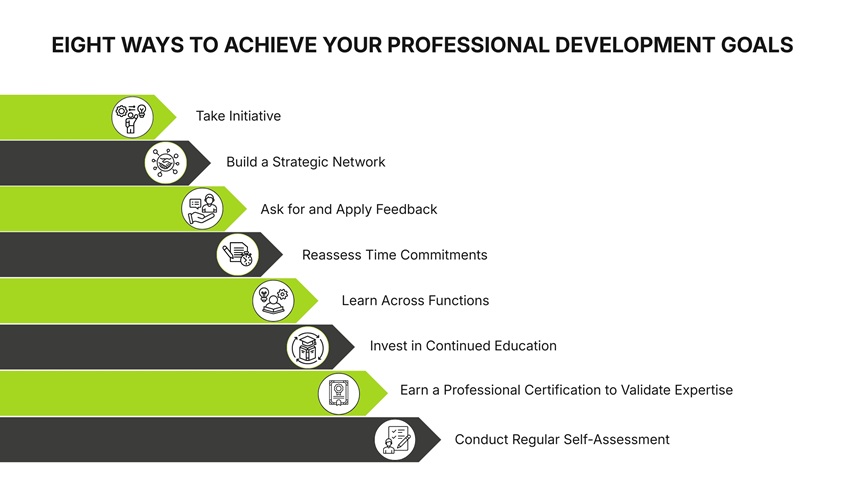
Here’s how:
- 1. Take Initiative
Professional growth requires ownership. Initiative often appears in practical forms: volunteering for complex assignments, proposing process improvements, or requesting broader responsibility.
Harvard Business Review has noted that proactive employees are more likely to be stronger contributors and innovators. Before advancing an initiative, assess workload capacity, consider cross-functional implications, and confirm alignment with strategic priorities. Initiative that supports both personal growth and business objectives builds credibility.
- 2. Build a Strategic Network
Networks provide access to information, sponsorship, and opportunities. Effective networking is deliberate rather than incidental. It involves identifying individuals who influence decisions and control resources.
Mapping influence patterns clarifies where insight and visibility originate. Externally, professional associations and industry forums broaden perspectives and expose emerging trends.
A strong network strengthens mobility and accelerates learning.
- 3. Ask for and Apply Feedback
Feedback remains one of the most reliable development tools. Zippia reports that 65 percent of employees want more feedback, even though many managers find delivering it uncomfortable.
Processing feedback requires more than acknowledgment. Harvard Business Review emphasizes reflection, follow-up conversations, and practice. Constructive input identifies strengths to leverage and gaps to address. Over time, this iterative refinement sharpens performance and improves decision-making.
- 4. Reassess Time Commitments
Ambitious goals often stall due to unrealistic scheduling. Skill acquisition demands consistent effort. Periodically reviewing workload and personal obligations ensures goals remain achievable.
Time audits can reveal low-value tasks that can be delegated or eliminated. Structured calendars that allocate dedicated learning blocks to protect progress. Sustainable pacing prevents burnout while maintaining momentum.
- 5. Learn Across Functions
Cross-functional exposure expands strategic awareness. Engaging colleagues from other departments clarifies how decisions intersect and where dependencies exist. This broader understanding improves collaboration and prepares professionals for leadership roles that require enterprise-level thinking.
Shadowing initiatives, project-based collaboration, or informal knowledge exchanges create insight without requiring formal role changes. The result is stronger systems thinking and improved communication.
- 6. Invest in Continued Education
Formal education remains a credible pathway for skill development. Master’s programs, executive courses, and professional certifications provide structured learning with defined outcomes.
Flexible online formats accommodate working professionals while preserving rigor. The key consideration is alignment with defined professional development goals and organization’s strategic priorities. Education should address identified capability gaps or prepare specific transitions, not serve as a generic credential.
Shorter courses focused on analytics, digital transformation, leadership, or emerging technologies often deliver immediate application value.
- 7. Earn a Professional Certification to Validate Expertise
Certifications carry greater value when they represent clearly defined professional capabilities. For example, STMP™ from TMI focuses on strategic talent management, including workforce strategy and leadership development. PDS™ from DASCA recognizes senior-level expertise in data science and signals the ability to influence technology strategy and drive innovation at the organizational level.
For professionals pursuing these credentials, preparation usually requires a structured study plan, milestone-based exam scheduling, and engagement with professional learning communities that sustain momentum and accountability.
Selecting the right professional certification often becomes the next important decision.
Here’s what you must consider:
1. Industry Relevance
Select certifications that reflect the capability standards recognized within your industry. Alignment with widely accepted credentials ensures the skills developed remain professionally relevant.
2. Cost and Long-Term Value
Review the full investment, including program fees, examinations, and preparation resources. The decision should consider the long-term value created through stronger capabilities and improved career mobility.
3. Time Commitment
Professtional certification pathways differ in duration and rigor. Evaluate the study requirements and ensure employees can realistically integrate learning with their professional responsibilities.
4. Addressing Skill Gaps
Certification choices should respond to clearly defined capability gaps within the organization. Targeted learning ensures development efforts contribute to evolving business priorities.
5. Credibility of the Issuing Institution
The standing of the certifying organization matters. Credentials from established and widely recognized institutions carry stronger professional acceptance.
- 8. Conduct Regular Self-Assessment
Progress requires measurement. Self-assessment supports accountability and informed adjustment.
In Leadership Principles, Harvard Business School Professor Joshua Margolis describes self-awareness as the ability to understand one’s strengths, weaknesses, and impact on others. Maintaining a written record of milestones, outcomes, and skill gains clarifies whether goals remain relevant and achievable.
Periodic reviews also strengthen performance discussions. Documented achievements provide concrete evidence of readiness for expanded responsibility.
Is Your Credential Working for You?
Use this checklist to see if your certification is truly adding value to your resume and career.Examples of Structured Professional Development Goals
Clear goals combine specificity, measurability, and time frames. Examples include:
- Expand SQL proficiency and complete a recognized certification within twelve months.
- Improve work-life balance by instituting defined sign-off times three days per week over six months.
- Prepare for a managerial role by drafting a development plan with a supervisor and leading three cross-team projects within a year.
- Attend one industry networking event each quarter and join a professional association by year-end.
- Build AI literacy by completing a foundational course and applying one AI tool weekly for three months.
Each example defines both the objective and the actions required to achieve it.
What Makes a Goal High-Impact?
High-impact goals share five characteristics:
- 1. Purposeful: They address a meaningful capability gap or advancement need.
- 2. Planned: They include structured steps and timelines.
- 3. Practical: They allow repeated application of new knowledge.
- 4. Performance-Oriented: They influence measurable outcomes.
- 5. Progressive: They evolve as responsibilities expand.
When goals meet these criteria, development shifts from abstract intention to observable advancement.
Final Thoughts
Professional development is most effective when treated as an ongoing discipline, guided by clear goals and consistent progress. The process is direct: identify where you stand, determine the capability required for your next stage, and design a plan with measurable milestones.
Here at Blazeprep we help identify trusted certifications that validate skills and support professional leadership development.
Ready to lead? Talk to our program advisor for your professional development journey today.
Frequently Asked Questions
What are some good goals for professional development?
Strong goals include strengthening leadership capability, improving data literacy, enhancing strategic communication, and building expertise in emerging technologies. Effective goals align personal growth with measurable organizational impact.
What are the 5 P’s of professional development?
The 5 P’s are Purpose, Plan, Practice, Performance, and Progression. They guide professionals in defining intent, structuring action, applying learning, measuring outcomes, and advancing over time.
What are 5 SMART goals examples for work?
SMART goals provide clarity, focus, and measurable outcomes. Examples include:
- 1. Launch a leadership development program by the end of Q3.
- 2. Earn a professional certification within six months.
- 3. Reduce employee onboarding time by 25% within the next year.
- 4. Increase the rate of internal promotions by 15% over 12 months.
- 5. Conduct quarterly employee engagement surveys and act on the results.
Each goal is Specific, Measurable, Achievable, Relevant, and Time-bound, providing a clear roadmap for tracking progress and achieving tangible outcomes.
What is an example of a developmental goal?
A developmental goal could involve strengthening executive coaching capability to better support senior leaders during organizational change. This builds influence while contributing to long-term continuity.