



Artificial intelligence (AI) has become a core component of modern enterprise systems, driving demand for professionals who can build, deploy, and manage intelligent solutions at scale. With AI projected by PricewaterhouseCoopers to contribute up to USD 15.7 trillion to the global economy by 2030, the field presents strong long-term prospects, diverse specialization options, and competitive compensation for those equipped with the right expertise.
Key Takeaways
- AI engineering has emerged as a critical role as organizations integrate artificial intelligence into core business systems and decision-making processes
- Mid to senior AI developers earn ~USD 8.1K–USD12.9K/month in North America and ~USD 3.8K–USD 7.9K in South America
- The field includes multiple specialized roles such as machine learning engineers, MLOps engineers, generative AI engineers, AI security specialists, and AI product leaders
- A solid foundation in computer science, mathematics, and statistics is essential for entering the field
- Proficiency in programming languages and machine learning frameworks is a core requirement for most roles
- Structured learning pathways, including certifications, support skill development and career progression
- Practical experience through projects and portfolios plays a significant role in securing AI engineering positions
This guide provides a structured overview of how to become an AI engineer, covering essential educational foundations, technical skills, and career pathways across industries.
What Is AI Engineering?
AI engineering involves applying artificial intelligence and machine learning techniques to design and build systems that improve operational efficiency, reduce costs, and support more informed business decisions. It focuses on translating models and algorithms into functional applications that can operate reliably within real-world environments.
AI engineering is concerned with the tools, systems, and processes that make artificial intelligence usable at scale. Systems that replicate aspects of human capability, such as learning from data or solving complex problems, fall within this domain. Algorithms are trained on data to improve performance over time, forming the basis of most AI-driven applications. This practical orientation toward deployment and integration is vital for understanding how the field currently operates in production environments.
Common examples of AI engineering in practice include recommendation systems on platforms such as Netflix, Spotify, and YouTube, where user behavior informs personalized content delivery. In transportation, AI supports the development of self-driving systems, while in healthcare, it enables applications such as robotic-assisted procedures and automated image-based diagnostics.
Role of AI Engineers Across Enterprise Systems
Artificial intelligence has entered large-scale production, supported by sustained enterprise investment and measurable operational impact. The global AI market is set to reach USD 3,497.26 billion by 2033, registering a CAGR of 30.6% from 2026 to 2033, according to a new report by Grand View Research, Inc. Corporate investment in AI continues to accelerate, with total investment exceeding USD 250 billion in 2024 and additional capital directed toward infrastructure, model development, and deployment systems.
AI adoption is now embedded across industries, with clear functional applications:
- Healthcare: diagnostic support, medical imaging analysis, and robotic-assisted procedures
- Finance: fraud detection, risk modeling, and algorithmic decision systems
- Retail: demand forecasting, inventory optimization, and personalization engines
- Education: adaptive learning systems and performance analytics
At the enterprise level, AI is used to improve efficiency, optimize decision-making, and develop new digital products. Most organizations now apply AI within at least one core business function, signaling a shift from experimentation to operational dependency.
This expansion has redefined the role of the AI engineer.
Why AI Engineering Is in High Demand
- Enterprise-wide AI adoption
AI is integrated across healthcare, finance, retail, manufacturing, and education, supporting automation, forecasting, personalization, and decision-making at scale. - Persistent talent gap
Demand for AI engineers exceeds supply, with a projected 30–40% shortfall in data and AI roles over the next few years. - Strong compensation levels
On average AI engineers command high salaries globally, with entry-level roles command around USD 103,407 annually, with an average additional salary to be approximately USD 32,000 per annum. - Expansion of specialized roles
The field includes MLOps engineers, AI product managers, prompt engineers, AI security specialists, and ethics and governance professionals. - Rising enterprise investment
Large-scale funding is directed toward AI infrastructure, model development, and deployment systems, directly increasing demand for engineering talent. - Shift to production-scale systems
Organizations require engineers who can deploy, integrate, and maintain AI systems in real-world environments, moving beyond experimental models.
Get tailored updates on certifications and future-ready skills.
Specializations in AI Engineering
AI engineering continues to expand into specialized roles aligned with different stages of the system lifecycle and industry applications. Key specializations include:
- Machine Learning Engineer
Develops, trains, and deploys models that process large-scale data for prediction, automation, and optimization. - Robotics Specialist
Designs and maintains AI-driven robotic systems used in automation, manufacturing, and physical operations. -
AI Architect
Defines system architecture, ensuring AI solutions align with business objectives, technical constraints, and governance standards. -
Intelligent Systems Engineer
Builds systems that manage, process, and deliver information efficiently for operational and analytical use. -
AI in Cybersecurity
Uses machine learning models to detect threats, automate responses, and strengthen data protection mechanisms. -
Computer Science and Software Engineering Roles
Focus on building underlying systems, tools, and applications that support AI development and integration.
How to Become an AI Engineer
AI engineering requires more than basic familiarity with models and tools. It demands depth in fundamentals, the ability to build systems, and evidence of applied work. The following AI engineer roadmap reflects how the field is currently evaluated by employers.
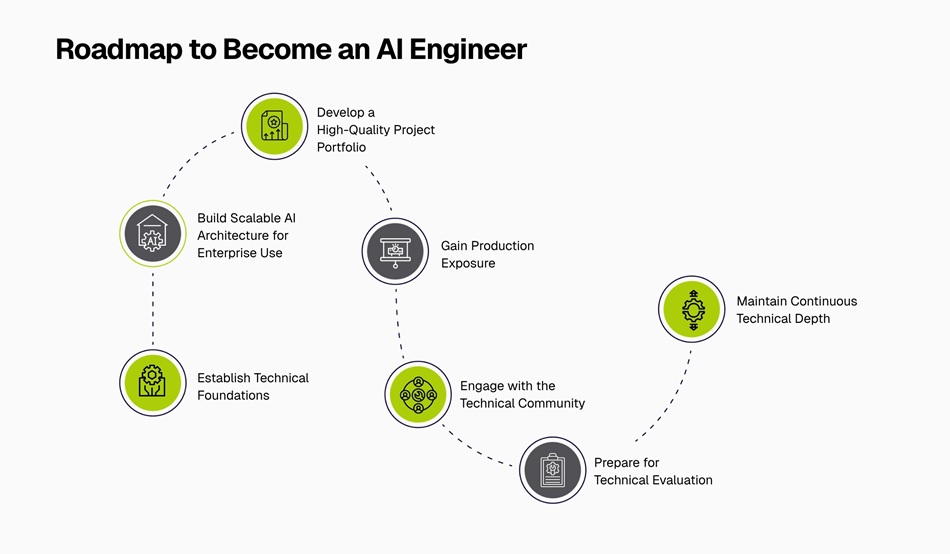
1. Establish Technical Foundations
Develop strong competence in Python, data structures, linear algebra, probability, and optimization. Move beyond basic model usage to understanding how algorithms behave under different data conditions. Most roles expect working knowledge of frameworks such as TensorFlow or PyTorch, along with experience handling real datasets. In addition to a formal degree, opting for a structured pathway, including the best AI engineer certification online like ARTiBA’s AiE® credential strengthens the ability to work with modern AI technologies, enables professionals to understand core modeling principles, and contribute meaningfully to AI-driven work in organizational settings.
2. Build Scalable AI Architecture for Enterprise Use
Training a model is insufficient. Focus on end-to-end workflows: data ingestion, preprocessing, model training, evaluation, and deployment. Projects should reflect real constraints such as noisy data, performance trade-offs, and scalability. Exposure to APIs, containerization, and basic cloud environments strengthens practical relevance.
3. Develop a High-Quality Project Portfolio
A credible portfolio demonstrates execution. Include a small number of well-developed projects with clear problem statements, architecture decisions, and measurable outcomes. Code quality, documentation, and reproducibility are assessed directly by hiring teams.
4. Gain Production Exposure
Internships, research roles, or structured project environments provide experience with production systems. This includes version control, collaboration workflows, and maintaining models post-deployment. Candidates with exposure to real-world constraints are often viewed more favorably.
5. Engage with the Technical Community
Active participation in technical communities supports skill development and industry engagement. Contributions to open-source projects, participation in competitions, and interaction with practitioners help refine problem-solving approaches and expose you to current tooling and practices.
6. Prepare for Technical Evaluation
AI engineering interviews assess three areas: coding ability, applied machine learning knowledge, and system design. Expect problem-solving in Python, discussions on model selection and evaluation, and scenarios involving deployment pipelines or scalable architectures.
7. Maintain Continuous Technical Depth
AI systems evolve rapidly, particularly in areas such as generative models and agent-based architectures. Long-term growth depends on consistent engagement with new frameworks, research developments, and system design patterns.
This how to become AI engineer roadmap reflects the current hiring expectations, where theoretical understanding, system-level thinking, and demonstrated execution define readiness.
Essential Skills and Tools for AI Engineers
AI engineering requires a combination of theoretical understanding, programming ability, and system-level execution. The role spans model development, data handling, and production deployment. This makes the job of an AI engineer inherently multidisciplinary.
-
Programming Languages
Python remains the primary language for AI development due to its extensive ecosystem, including TensorFlow, PyTorch, and scikit-learn. R is used in statistical analysis, Java in enterprise-scale systems, and C++ in performance-critical environments such as robotics. Familiarity with more than one language improves flexibility across use cases. - Machine Learning and Deep Learning
Strong understanding of model architectures, including regression, tree-based models, neural networks, and transformers. Practical experience with frameworks such as TensorFlow, Keras, PyTorch, and scikit-learn is expected. Skills in model evaluation, hyperparameter tuning, and transfer learning are essential for real-world applications. -
Mathematics and Statistics
Linear algebra, calculus, probability, and optimization form the foundation of how models learn and perform. This knowledge supports model selection, debugging, and performance improvement. -
Big Data and Cloud Computing
Experience with distributed systems such as Hadoop and Apache Spark is important for handling large datasets. Proficiency in SQL and familiarity with cloud platforms such as AWS, Google Cloud, or Azure is increasingly required for scalable AI deployment. -
MLOps and Deployment
Ability to move models into production environments using tools such as Docker, Kubernetes, and CI/CD pipelines. Experience with APIs, version control, and workflow tools like MLflow or Kubeflow is critical for integrating AI into applications. -
AI Ethics and Explainability
Understanding bias, fairness, and interpretability is expected. Techniques such as feature importance analysis and model explanation tools support transparency and compliance.
AI engineering requires continuous skill development. Tools, frameworks, and model architectures evolve rapidly, making ongoing learning a core requirement for long-term success.
Wrapping Up
AI engineering has established itself as a critical discipline at the intersection of machine learning, software engineering, and scalable system design. As organizations continue to operationalize AI across core functions, the need for engineers who can move from models to production remains strong. Following a structured approach on how to become an AI engineer ensures alignment with current industry expectations, while a well-defined roadmap builds depth in both theory and execution.
For those seeking guided progression, here at Blazeprep, we help you identify where you stand, determine the capability required for your next stage, and design a plan with measurable milestones. Get the best AI engineer certification online for practical, job-ready skills, supporting long-term growth in an increasingly competitive field.
Talk to our program advisor to discuss professional development options.