



Global technology ecosystems have scaled faster than their leadership pipelines. Representation at entry-level roles has expanded over the past decade, yet the progression into senior positions remains disproportionately narrow for women.
Although women account for nearly half of the global workforce, the World Economic Forum (WEF) notes that their presence in senior leadership remains below one-third. Women hold just 28.1% of senior leadership positions globally, despite accounting for nearly half of the workforce.
Together, these patterns illustrate a structural gap in how organizations cultivate and advance female leadership.
Governments across the globe need to place greater emphasis on expanding leadership opportunities for women in technology, focusing more on mid-career professionals. Beyond equity, this effort is critical to shaping the future of technology leadership and workforce design.
A Critical Inflection Point for Careers
Women’s contributions to technology form some of the discipline’s deepest foundations, from Ada Lovelace’s conceptualization of algorithmic logic to Grace Hopper’s work on compilers and the popularization of debugging, and the mathematical and computational breakthroughs advanced by Katherine Johnson, Mary Jackson, and Dorothy Vaughan. Long before tech became an industry, women shaped the architecture of modern computing.
Despite this legacy, today’s participation patterns reflect a persistent imbalance. This is not a pipeline problem as much as it is a trajectory problem.
Globally, only about 42% of working-age women participate in the global workforce. In many economies, women occupy less than one-fourth of leadership roles in STEM fields. Even with improvements in early-career hiring, attrition remains steep: nearly half of women in technology exit the sector by age 35.
As the digital economy matures, career progression depends increasingly on the ability to navigate AI-led business models, complex governance requirements, and multidimensional stakeholder environments.
Why It Matters for Career Growth
UK Technology Secretary Liz Kendall pointed out, "When women are inspired to take on a role in tech and have a seat at the table, the sector can make more representative decisions, build products that serve everyone." BCS, the Chartered Institute for IT, reports that women account for just 22% of IT specialist roles in the UK. The representation of women continues to lag significantly behind that of men.
Although early-career representation has improved, mid-career remains the decisive bottleneck. This is the stage where career breaks, uneven access to stretch opportunities, and limited mentorship networks can compound into slower advancement or complete workforce exit.
As modern technology organizations are recalibrating their talent models around hybrid roles that blend advanced digital capability with leadership judgment, a combination in short supply globally.
Representative examples include:
- Product Managers and Product Strategy Leads steering AI-enabled platforms
- Tech Leads and Engineering Managers guiding distributed development teams
- Data Science Leads and AI Specialists embedding algorithmic decision-making
- Cybersecurity Architects and Privacy Leads safeguarding expanding digital estates
These positions require professionals who can integrate technical literacy with strategic insight, and operate confidently cross-functional, fast-evolving environments.
A Timely Government Policy Intervention
Across regions, governments are adopting multi-stakeholder approaches to support women’s long-term participation and leadership in technology.
- In December 2025, the UK government launched the Women in Tech Taskforce, signaling a shift from access-focused interventions to sustained career progression and leadership outcomes. Led by Technology Secretary Liz Kendall, this initiative aims to help more women enter, stay and lead in the UK's tech sector.
- India’s proposed Women in Global Tech Missions under IT Policy 2025–2030 intends to prepare 1,000 mid-career women for leadership roles through advanced skilling, international exposure, and industry-linked immersion. This is the stage at which career breaks, caregiving responsibilities, and uneven access to high-impact assignments converge, often pushing experienced professionals out of leadership trajectories just as their institutional value peaks.
- The same structural patterns appear in regions where technology talent pipelines are still being built. In Africa, the Power Learn Project, in partnership with UN Women, concentrates on early-career technical training as a lever for addressing gender imbalance. More than 20,000 developers have completed the program to date, with women making up about 40% of its latest cohort, suggesting that participation gaps are influenced as much by entry design as by later-stage advancement.
- Aligned with the African Girls Can Code Initiative, the above-mentioned program blends technical training with applied problem-solving through regional hackathons that address issues such as digital safety and gender-based violence.
What Mid-Career Professionals Can Learn
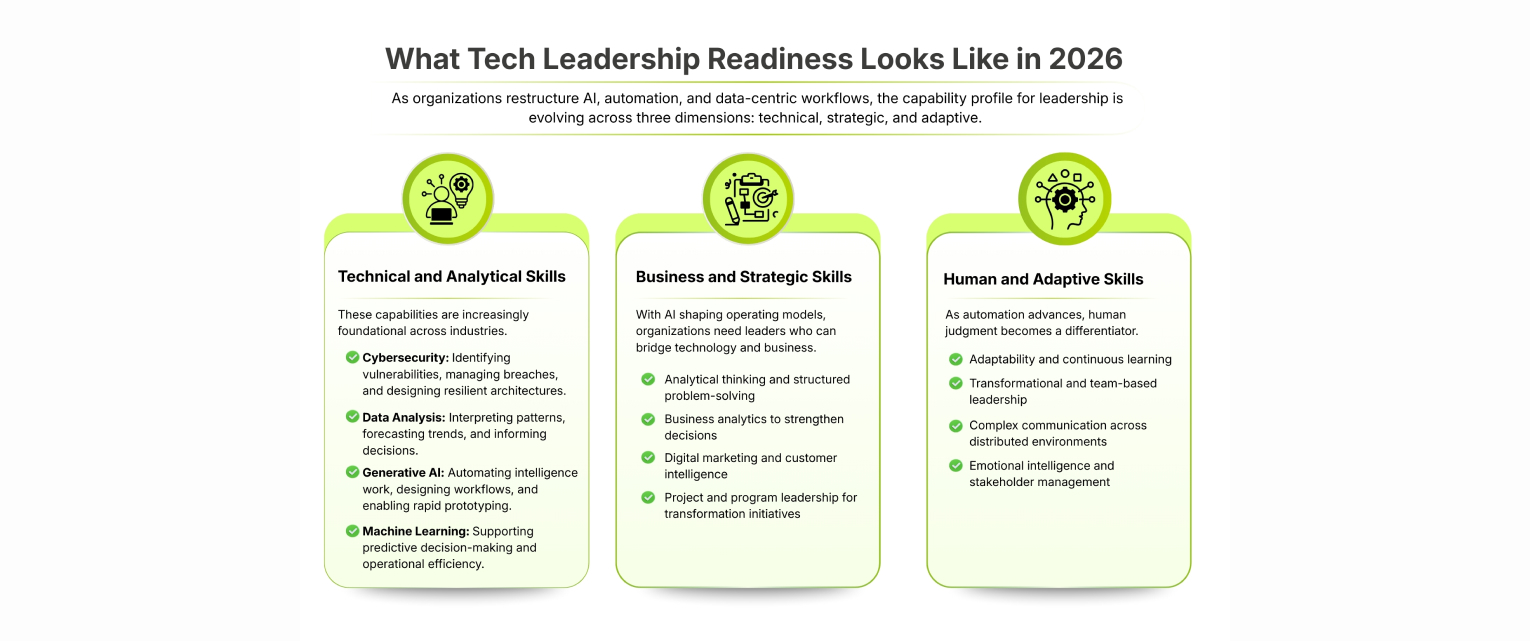
For professionals transitioning into technology-focused leadership roles, the priorities are becoming more clearly defined. At this stage, credibility is no longer built on past titles or years of experience alone. It rests on whether one can operate confidently in technology-mediated environments and take ownership where business and technology intersect.
As organizations rely more heavily on digital platforms, data, and AI-enabled systems, leadership readiness is judged by how effectively individuals navigate complexity, uncertainty, and cross-functional dependence.
This typically shows up in a leader’s ability to:
- Lead initiatives where technology, business, and risk considerations converge
- Make sound decisions in unfamiliar or fast-evolving technical contexts
- Translate strategic intent into outcomes, not just oversight activity
- Acknowledge missteps, course-correct, and articulate learning
- Influence technology-related decisions beyond formal reporting lines
For many, this phase represents a deliberate shift rather than a linear progression.
Use Certifications as Career Accelerators
In this transition, certifications can be practically useful. They are not substitutes for leadership experience, nor do they confer automatic credibility. What they offer is structure.
Credentials influence career progression because they align with these commonly evaluated indicators:
- Skills verification — standardized assurance that an individual can perform to defined professional benchmarks.
- Signal of commitment — the willingness to invest time and resources in certification indicates seriousness, reliability, and long-term intent.
- Continuing relevance — ongoing learning requirements ensure credential holders remain current as skills, technologies, and expectations evolve.
Certifications function as bridging mechanisms in career transitions by making prior experience and latent capability legible in new contexts. They provide a standardized signal that helps organizations assess readiness when a professional moves into an unfamiliar industry or role, reducing assessment uncertainty without implying mastery of all domain-specific knowledge.
In areas such as IT governance, AI, cybersecurity, and program leadership, certifications can reduce the learning curve that often slows mid-career transitions. These tend to add the most value when they strengthen tech leadership capabilities such as:
- Interpreting AI and digital systems well enough to inform leadership judgment
- Using data to evaluate options, risks, and performance implications
- Understanding cybersecurity and technology risk at a governance level
- Leading programs and platforms with a systems-level, not functional, mindset
Used this way, certifications help mid-career professionals bridge experience gaps, accelerate credibility in new contexts, and demonstrate readiness for technology leadership.
Conclusion
There is a broader evolution in how organizations define leadership capability in the technology sector.
Technical expertise remains necessary, but effective leadership increasingly requires the ability to navigate complex systems, integrate diverse perspectives, and make decisions in data-rich, fast-changing environments.
For mid-career women, these inflection points are critical opportunities to expand influence and assume broader leadership roles. Certifications and structured development pathways reinforce this shift by translating experience into legible signals of readiness and supporting the application of strategic, systems-level thinking.
The message is clear: the future belongs to those who can integrate AI literacy, strategic insight, and adaptive leadership into their career pathways.